

Digital Fault Recorders (DFRs) Market Types, Industry Trends, Revenue Status and Global Outlook 2026 To 2035
Digital fault-recorder market 2026
North America led the Digital Fault Recorder Market with 37.85% share in 2025, anchored by NERC reliability-standard enforcement.
Dedicated digital fault recorders captured 53.90% of Digital Fault Recorder Market revenue in 2025, reflecting utility preference for purpose-built waveform capture in mission-critical substations.”
NY, CA, UNITED STATES, July 15, 2026 /EINPresswire.com/ -- Digital Fault Recorders (DFRs) are advanced electronic devices used in electric power systems to capture and record detailed waveform data during fault events such as short circuits, voltage sags, and switching transients. These devices provide critical post-event analysis capabilities, enabling engineers to understand fault characteristics, locate disturbances, and optimize protection system settings for improved grid reliability and resilience.— Arti Dhapte
Digital Fault Recorder Market Overview
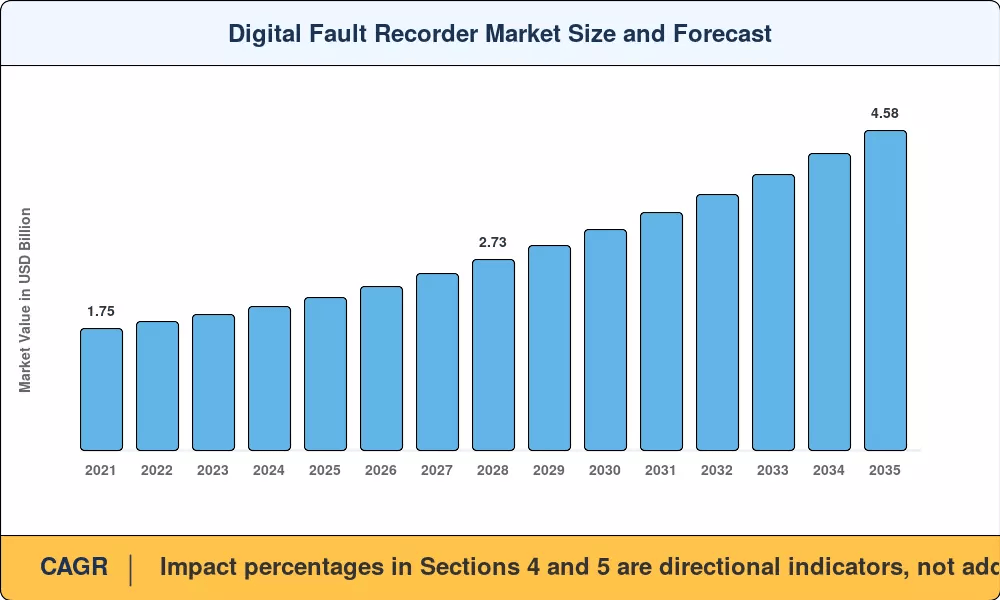
The Digital Fault Recorder Market share was valued at USD 2.19 billion in 2025 and is projected to reach USD 2.35 billion in 2026, climbing to USD 4.58 billion by 2035 at a compound annual growth rate of 7.65% during the 2026–2035 forecast window. This expansion is anchored in record grid-modernization budgets — the U.S. Department of Energy alone has earmarked over USD 20 billion through the Grid Resilience and Innovation Partnerships (GRIP) program, while the European Union's revised TEN-E regulation channels investment into cross-border transmission upgrades. These public capital flows translate directly into procurement cycles for high-fidelity disturbance-capture platforms that legacy electromechanical relays simply cannot serve.
The market is experiencing robust growth driven by several key factors. Grid-modernization public funding programs, particularly in North America and Europe, have created historically unprecedented procurement pipelines. The U.S. Bipartisan Infrastructure Law allocates USD 65 billion to grid upgrades, with GRIP distributing USD 10.5 billion specifically for resilience-focused projects that typically specify digital oscillographic equipment. Renewable integration and the proliferation of inverter-based resources are fundamentally altering fault signatures on transmission and distribution networks, creating demand for high-resolution waveform capture that conventional relays cannot provide. Regulatory compliance mandates, including NERC Standard PRC-002-3 in North America and India's Central Electricity Authority Grid Standards, require mandatory oscillographic recording at high-voltage substations, with non-compliance penalties reaching USD 1 million per violation per day.
Industry trends indicate a fundamental shift from aging analog strip-chart recorders and first-generation microprocessor units to IEC 61850-native platforms capable of synchronized phasor capture, GPS-timestamped waveform storage, and cloud-based analytics integration. The migration to process-bus architectures in digital substations is accelerating, with utilities increasingly specifying recorders that support routable-GOOSE and routable-SV profiles for wide-area communication beyond single substations.
Technological developments are reshaping the market landscape. Edge-AI fault classification and predictive analytics enable real-time automatic fault categorization at the substation, reducing mean-time-to-restore by up to 35%. AI-driven autonomous fault analysis is transforming recorders from passive data-capture devices into active diagnostic agents capable of classifying disturbance types, identifying incipient equipment failures, and triggering automated protection scheme adjustments within sub-second timeframes. Cloud-hosted analytics platforms are shifting value from hardware margins to recurring software subscriptions, enabling fleet-wide waveform analysis and benchmarking across geographically dispersed substations.
Policy and regulatory influence continues to shape market dynamics. NERC PRC-002-3 requires all transmission owners in North America to capture and retain disturbance data from fault recorders at facilities operating at 200 kV and above. ENTSO-E's System Operation Guideline imposes equivalent data-retention obligations on European TSOs. India's CEA Grid Standards mandate digital fault recording at all 220 kV-and-above substations, covering more than 400 installations in the national grid. The EU Taxonomy's "do no significant harm" criteria reference network reliability as a reportable metric, linking fault recorder deployment to sustainability-reporting requirements.
North America commands a 37.85% share of the digital fault recorder market, reinforced by NERC PRC-002 compliance obligations and a mature installed base undergoing lifecycle replacement. Asia-Pacific is the fastest-growing region at a 7.85% CAGR, propelled by ultra-high-voltage corridor buildouts in China and rapid rural electrification across Southeast Asia. Europe holds the second-largest position with approximately 25.50% share, driven by offshore wind integration and TSO digitalization programs.
Get Free Sample Report for Detailed Market Insights:
https://www.marketresearchfuture.com/sample_request/6986
Digital Fault Recorder Market Segmentation
By Type
Dedicated Digital Fault Recorders: Captured 53.90% of market revenue in 2025, reflecting utility preference for purpose-built waveform capture in mission-critical substations
Multifunction Devices: Expanding at a 9.50% CAGR through 2035, driven by cost consolidation strategies in distribution-level deployments
By Installation
Transmission: Held USD 1.11 billion in 2025, underpinned by mandatory oscillographic capture requirements at high-voltage interconnection points
Distribution: Advancing at a 7.95% CAGR as distributed energy resources drive fault-pattern complexity at medium-voltage levels
Generation: Valued at USD 0.38 billion, serving turbine-generator protection and commissioning validation
By Voltage Class
<110 kV: Growing at 6.75% CAGR for distribution automation and DER monitoring
110–220 kV: Held 46.50% share as backbone sub-transmission and regional grid hubs
220–500 kV: Growing at 7.45% CAGR for UHV corridor terminals and bulk power transfer
>500 kV: Valued at USD 0.19 billion for China/India UHV AC/DC converter stations
By Communication Protocol
IEC 61850-Compliant: Commanded 55.90% share with process-bus architecture migration and interoperability mandates
Legacy/Proprietary: Valued at USD 0.97 billion for installed-base maintenance and brownfield retrofits
By End User
Utilities: Dominated with 40.65% share driven by grid-code compliance and reliability-metric reporting
Industrial & Manufacturing: Valued at USD 0.42 billion for process continuity and power-quality assurance
Data Centers: Fastest-growing at 7.45% CAGR for Tier III/IV certification and hyperscale campus PQ monitoring
Others (Railways, Mining, O&G): Growing at 5.95% CAGR for electrified traction networks and remote-site grid stability
Competitive Landscape / Key Players
The digital fault recorder market exhibits medium concentration, with the top five companies estimated to hold 45-52% of global revenue. Differentiation increasingly hinges on analytics software capabilities, IEC 61850 native integration depth, and cybersecurity certification credentials rather than raw hardware specifications.
Schweitzer Engineering Laboratories (SEL) (~12-15% revenue share): Offers SEL-2407, SEL-734 Satellite-synchronized recorders with vertically integrated R&D and dominant position in North American utility sector.
ABB Ltd. (Hitachi Energy) (~10-13%): Provides REL670, REC650 integrated recorder-relay platforms with global footprint and strong IEC 61850 ecosystem integration.
Siemens Energy (~8-11%): Features SIMEAS R-PMU, SIPROTEC 7KE85 fault recorders with European TSO relationships and software-defined protection portfolio.
GE Vernova (~7-10%): Offers Multilin F60 and D90Plus fault-recording relays leveraging installed base across GE turbine-generator fleet.
Qualitrol (Hitachi Energy) (~5-8%): Provides IDM+ Intelligent Digital Monitor converging asset health monitoring with DFR power system disturbance analysis.
Other notable players include Ametek Inc., Elspec Ltd., ERLPhase Power Technologies, Kinect Energy (Yokogawa), and Mehta Tech Inc. Recent developments include Siemens launching the first building complex of the Siemens Technology Center at the Garching Research Campus in Munich to accelerate innovation in digital grid technologies.
You can buy this market report at:
https://www.marketresearchfuture.com/checkout?currency=one_user-USD&report_id=6986
Digital Fault Recorder Market Regional Analysis
North America
North America commands a 37.85% share of the digital fault recorder market, reinforced by NERC PRC-002 compliance obligations and a mature installed base undergoing lifecycle replacement. The United States drives 78.5% of regional revenue, reflecting the scale of its interconnected bulk power system and the enforcement muscle of NERC reliability standards. FERC Order 2023 and related interconnection queue reforms are accelerating new transmission builds, each requiring digital oscillographic equipment at the point of interconnection. Canada's provinces, notably Ontario and Alberta, are investing in recorder upgrades as they integrate growing wind and solar portfolios into aging provincial grids. Mexico's Comisión Federal de Electricidad has included digital fault recording specifications in its 2024-2028 transmission expansion program targeting 18 new 400 kV substations.
Europe
Europe holds the second-largest position with approximately 25.50% share, driven by offshore wind integration and TSO digitalization programs. Germany leads with a 7.35% CAGR, driven by Energiewende offshore wind corridors requiring IEC 61850-native fault recorders across North Sea converter stations. The United Kingdom's RIIO-T2 network investment framework and National Grid ESO's Pathfinder framework have embedded digital oscillography requirements. France's nuclear fleet renewal and grid interface upgrades, Italy's Terna smart-grid digitalization plan, and Spain's solar-heavy generation mix requiring advanced waveform capture contribute to regional growth. The European Network of Transmission System Operators mandates standardized disturbance data formats under its System Operation Guideline, creating a harmonized compliance framework that simplifies cross-border procurement.
Asia-Pacific
Asia-Pacific is the fastest-growing region at a 7.85% CAGR, propelled by ultra-high-voltage corridor buildouts in China and rapid rural electrification across Southeast Asia. China single-handedly accounts for over 42.5% of regional revenue, driven by State Grid's USD 45+ billion UHV construction program and the sheer number of new substations entering service annually. India is the region's fastest-growing country-level opportunity at an 8.45% CAGR, propelled by the CEA's mandatory digital oscillographic recording mandate and the Green Energy Corridor Phase II expansion. Japan's post-Fukushima grid resilience reforms continue to generate replacement demand at TEPCO and Chubu Electric substations. South Korea's KEPCO has earmarked KRW 2.3 trillion for smart-grid upgrades through 2030.
Rest of the World
South America, led by Brazil with 62.0% of regional share, is modernizing grid codes with ANEEL's revised requirements mandating digital disturbance recording at all 230 kV-and-above substations. The Middle East & Africa region sees Saudi Arabia's Vision 2030 program channeling billions into smart-grid infrastructure, including digital protection and monitoring systems at new industrial cities. The UAE's DEWA has implemented comprehensive digital substation standards mandating fault recording with IEC 61850 connectivity. Sub-Saharan Africa presents long-term greenfield opportunity as Mission 300 and similar electrification programs build new transmission networks from scratch.
Latest Industry News & Developments
Siemens (April 2024): Launched the first building complex of the Siemens Technology Center at the Garching Research Campus in Munich, consolidating corporate research efforts and collaborating with the Technical University of Munich to accelerate innovation in digital grid technologies.
India CEA (2023): Mandated digital oscillographic recording at all 220 kV-and-above substations under its Grid Standards, creating a compliance-driven refresh cycle across the country's 400-plus extra-high-voltage substations.
U.S. DOE (2024): Announced GRIP program selections distributing USD 10.5 billion for resilience-focused projects, specifying digital oscillographic equipment in procurement packages.
Digital Fault Recorder Market Challenges & Opportunities
Key Restraints
Semiconductor supply constraints for specialized analog-to-digital converters, FPGAs, and precision timing components have extended lead times to 26-38 weeks, creating order-backlog uncertainty for mid-tier OEMs. High upfront costs for standalone dedicated recorders, ranging from USD 25,000-45,000 per unit before installation, lengthen capital-approval cycles among smaller utilities. Interoperability challenges with legacy SCADA infrastructure, as 38% of utilities cite legacy integration complexity as the primary reason for delaying deployment at brownfield substations. Cybersecurity concerns with networked recording devices and skilled workforce shortages for commissioning and data analysis further constrain growth.
Emerging Opportunities
Edge-AI fault classification and predictive analytics enable transformation from reactive post-event analysis to real-time automatic fault categorization, reducing mean-time-to-restore by up to 35%. Data-center power-quality monitoring represents a high-growth vertical, with hyperscale and colocation facilities requiring continuous power-quality recording at the point of common coupling. Emerging-market rural electrification programs in Sub-Saharan Africa and Southeast Asia create greenfield installation bases free from legacy-integration problems. Recorder-as-a-Service and subscription models shift capex to opex and combine continuous firmware updates with cybersecurity patching. Offshore wind and subsea cable monitoring presents a specialized niche commanding premium pricing with barriers to entry for manufacturers without marine-grade product certifications.
Future Potential
AI-driven autonomous fault analysis will transform fault recorders into active diagnostic agents capable of classifying disturbance types, identifying incipient equipment failures, and triggering automated protection scheme adjustments within sub-second timeframes. Platform economics and ecosystem lock-in are shifting the market from hardware-centric transactions toward platform-based ecosystems where OEMs compete on software capabilities, cloud analytics dashboards, and API interoperability. The electrification supercycle, with global electricity demand forecast to grow by 75-80% between 2025 and 2050, provides a structural demand floor. ESG reporting and grid-resilience metrics are pushing regulated utilities to instrument networks with higher-fidelity monitoring equipment, linking the market to the broader sustainability-reporting ecosystem.
To explore more market insights, visit us at:
https://www.marketresearchfuture.com/reports/digital-fault-recorder-market-6986
Final Market Summary
The global Digital Fault Recorder Market is positioned for sustained growth, with projections indicating expansion from USD 2.35 billion in 2026 to USD 4.58 billion by 2035 at a 7.65% CAGR. Market dynamics are driven by the convergence of grid-modernization public funding, renewable integration challenges, and regulatory compliance mandates. The shift from legacy analog and proprietary devices to IEC 61850-native, analytics-ready platforms is transforming the market landscape.
North America remains the dominant market with 37.85% share, reinforced by NERC compliance and lifecycle replacement cycles, while Asia-Pacific delivers the fastest regional growth at 7.85% CAGR driven by UHV corridor buildouts and rural electrification. Europe follows with 25.50% share supported by offshore wind integration and TSO digitalization programs. While challenges including semiconductor supply constraints and interoperability with legacy infrastructure persist, the long-term industry outlook remains robust, supported by the essential role of digital fault recorders in enabling resilient, self-healing power grids for the energy transition supercycle. The decade ahead will test how quickly utilities adopt edge-AI analytics and cloud platforms to extract actionable insights from the massive waveform data streams that modern digital fault recorders generate.
More Related Reports from MRFR Library:
Gas Cleaning Technologies Market https://www.marketresearchfuture.com/reports/gas-cleaning-technologie-market-32353
Power Rental System Market https://www.marketresearchfuture.com/reports/power-rental-system-market-32357
Prime Power Reciprocating Power Generating Engine Market https://www.marketresearchfuture.com/reports/prime-power-reciprocating-power-generating-engine-market-32361
Private Electric Vehicle Charging Station Market https://www.marketresearchfuture.com/reports/private-electric-vehicle-charging-station-market-32412
Oil Immersed Fixed Shunt Reactor Market https://www.marketresearchfuture.com/reports/oil-immersed-fixed-shunt-reactor-market-32442
Orc Industrial Waste Heat To Power Market https://www.marketresearchfuture.com/reports/orc-industrial-waste-heat-to-power-market-32446
Pdc Drill Bit Market https://www.marketresearchfuture.com/reports/pdc-drill-bit-market-32447
Pem Small Capacity Electrolyzer Market https://www.marketresearchfuture.com/reports/pem-small-capacity-electrolyzer-market-32450
Residential Smart Gas Meter Market https://www.marketresearchfuture.com/reports/residential-smart-gas-meter-market-32452
Solar Energy Panel Market https://www.marketresearchfuture.com/reports/solar-energy-panel-market-32454
Larry Wilson
WantStats Research And Media Pvt. Ltd.
+1 855-661-4441
email us here
Visit us on social media:
LinkedIn
Facebook
YouTube
X
Legal Disclaimer:
EIN Presswire provides this news content "as is" without warranty of any kind. We do not accept any responsibility or liability for the accuracy, content, images, videos, licenses, completeness, legality, or reliability of the information contained in this article. If you have any complaints or copyright issues related to this article, kindly contact the author above.
