

AI Agents Complete 1.4 Million Business Tasks a Month. The Majority Run on Gemini
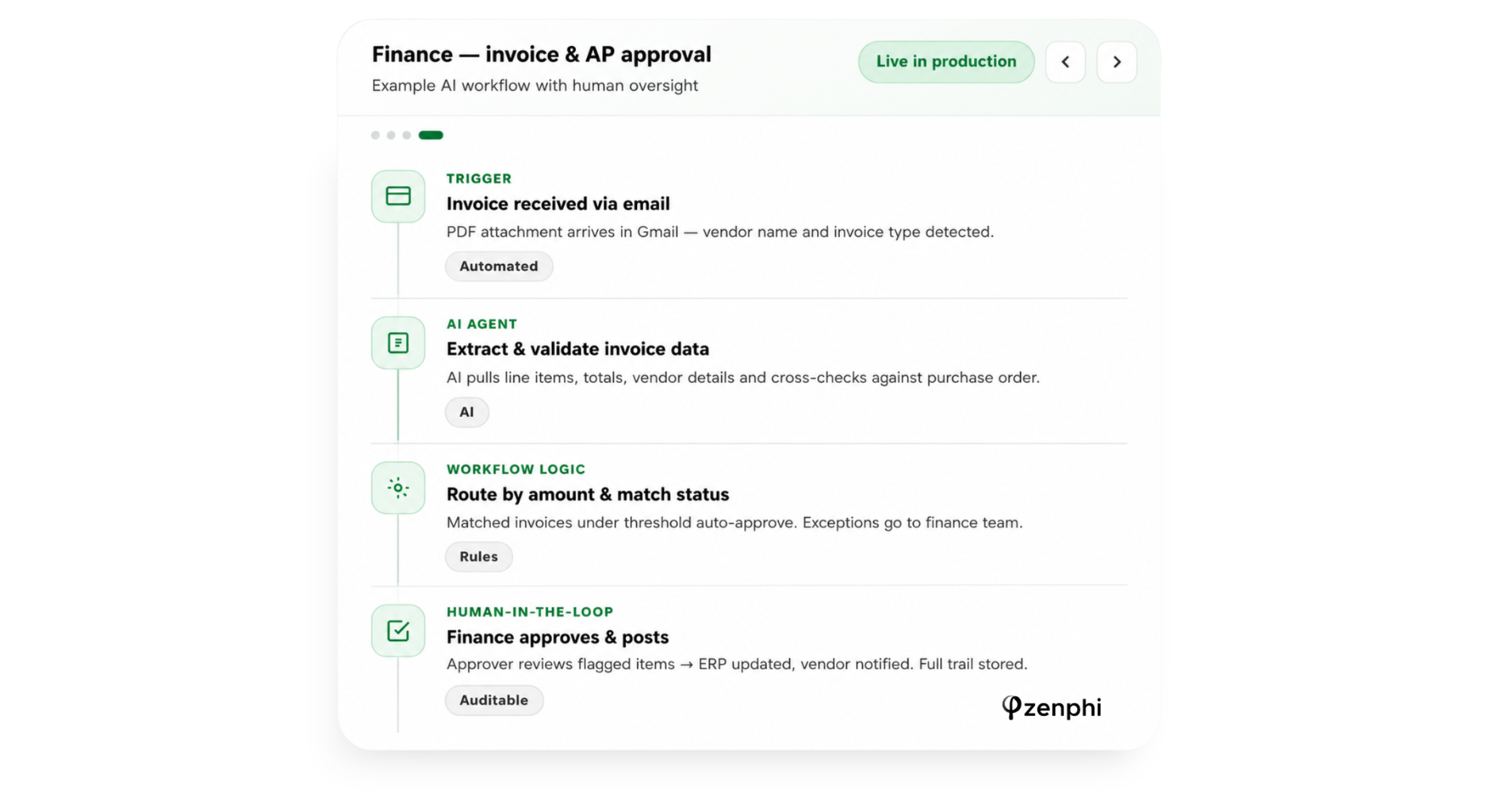
Example of a finance agent in production – courtesy of a procurement company from Florida using Zenphi to design, deploy and manage this agent
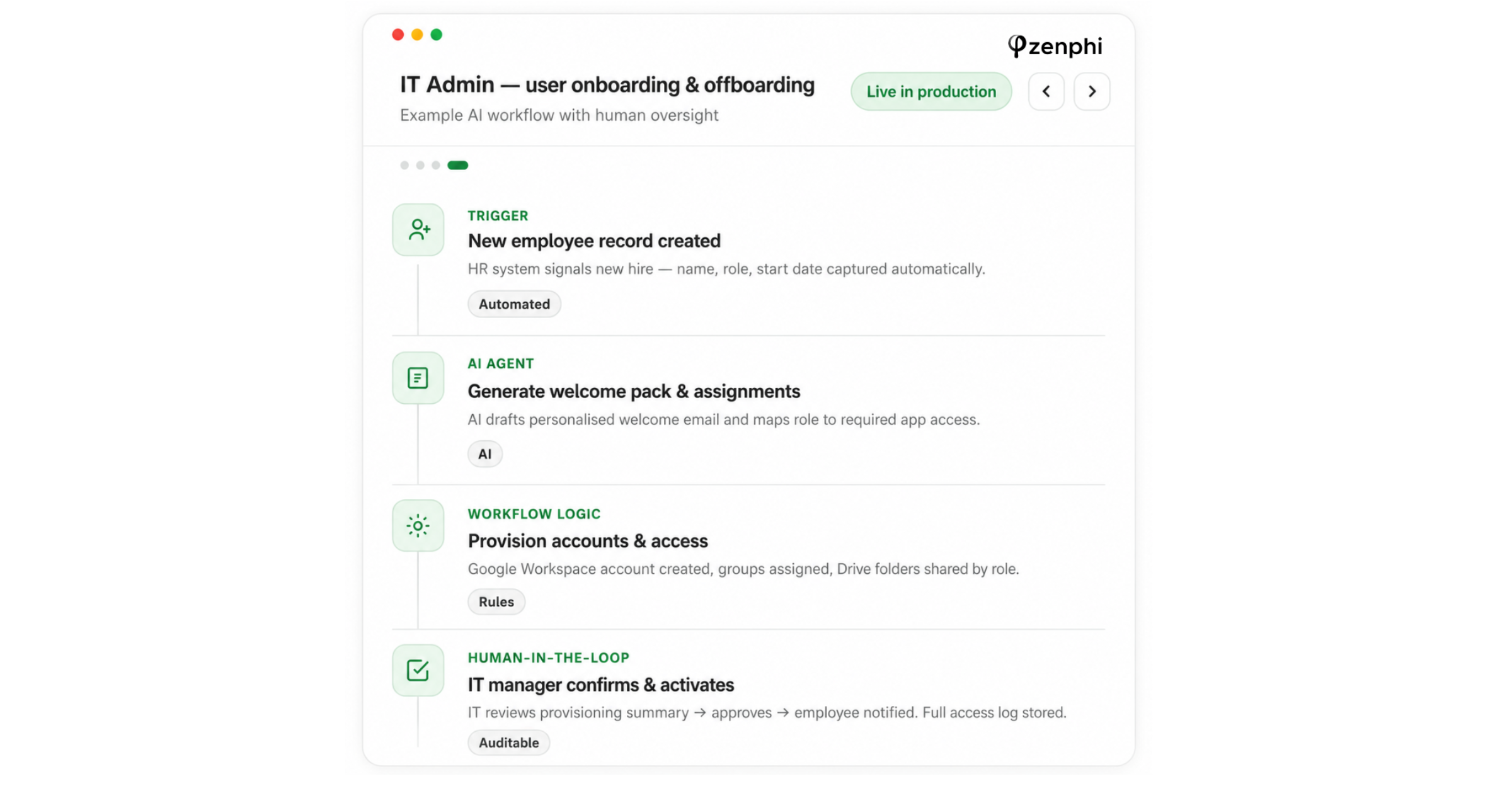
AI agent for IT Ops for secure employee onboarding, access provisioning, and approval-based activation — built, deployed and managed in Zenphi
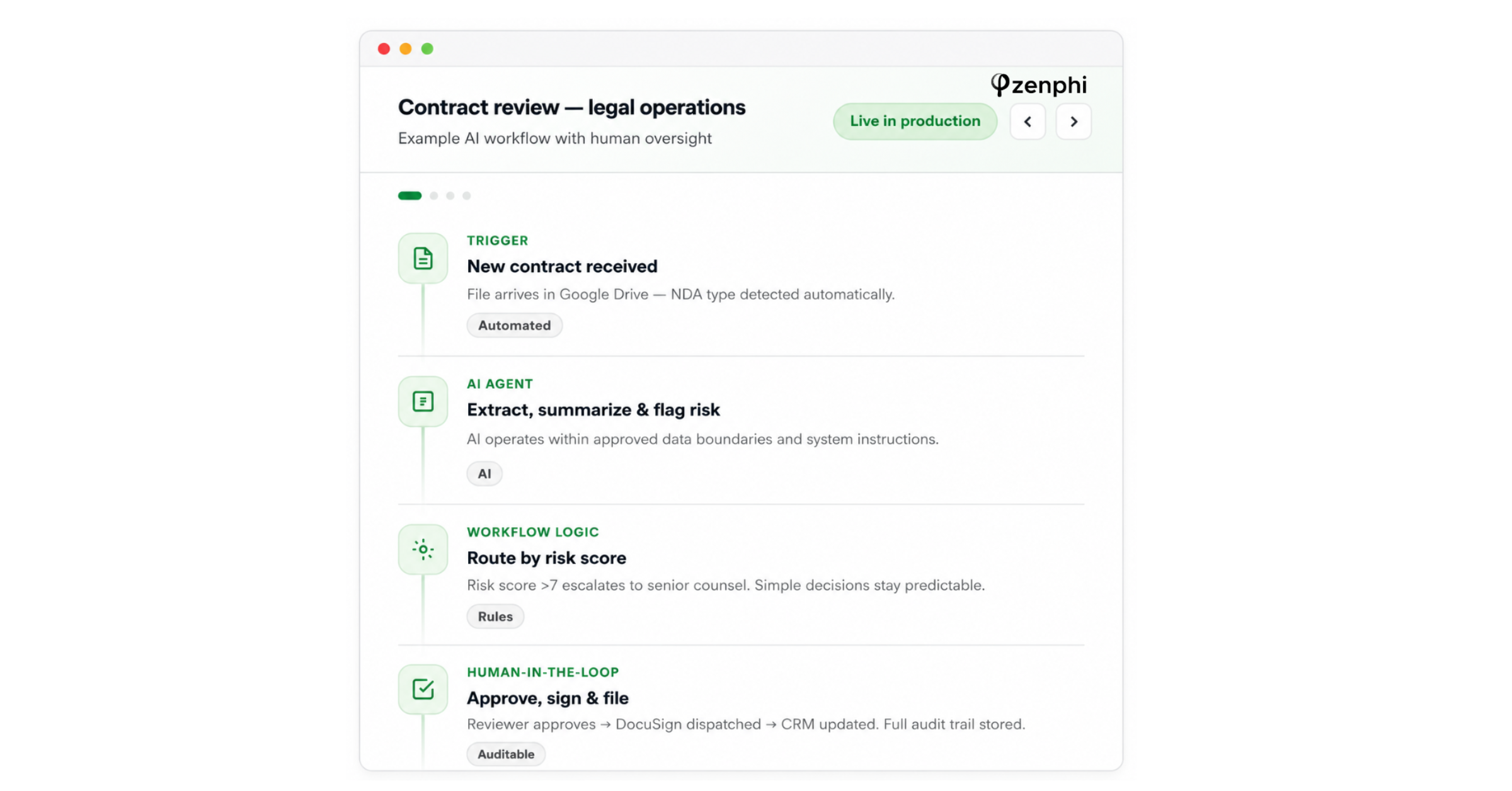
Contract review agent for legal teams, combining automated risk analysis with human approval, e-signature dispatch, CRM updates, and audit-ready filing. Designed, deployed and managed in Zenphi.
Production figures from Zenphi's customer base offer a look at how businesses are putting Gemini to work — and why architecture is what makes AI agents stick.
These are not demos, pilots, or isolated chatbot interactions. They are real-world tasks triggered by real business processes across healthcare, education, logistics, technology, and professional services. They include document extraction, classification, summarization, proposal drafting, operational decision support, data processing, and other AI-powered steps executed inside governed workflows. That number matters beyond its size. It is one of the clearest signals yet that the production AI problem many organisations are still wrestling with, is the architecture to make AI work consistently and economically enough to trust it with real operations.
The gap nobody talks about
The dominant narrative in enterprise AI is that teams are stuck in pilot purgatory — running experiments that work in controlled conditions and fail in production. The usual explanations focus on models: hallucination rates, context limits, cost per token.
Zenphi's production data points to a different bottleneck. The 1.4 million tasks running through its platform each month share a common architectural pattern: AI is not being asked to run entire workflows autonomously. It is embedded as a processing step inside governed, structured workflows — with defined inputs, clear success criteria, human-in-the-loop checkpoints where judgment is needed, and audit trails throughout.
The result is that AI does what it is actually good at — extracting, classifying, summarising, drafting — while the surrounding workflow handles the parts that require accountability, permissions, and integration with other systems.
"Organisations today have plenty of AI tools to experiment with," said Vahid Taslimi, CEO of Zenphi. "Yet, most struggle with making AI reliable, governed, and scalable enough to trust with real operations. Our customers have graduated from that stage."
Token economics at production scale
One factor that always surfaces in AI deployment discussions is token cost sustainability. Replacing every workflow step with a generative AI call is economically unviable at production volumes — and architecturally fragile. The answer to this dilemma turns out to be quite simple: steps that do not need AI should not use it. AI should be invoked where its contribution to output quality justifies the cost.
The agents and AI workflows in production that lead to Zenphi's 1.4 million monthly tasks are built on this principle. AI is applied selectively — to the steps where language understanding, pattern recognition, or generative output create real value. The rest of the workflow runs on structured logic. That balance is what makes production-scale AI economically sustainable.
A significant portion of these tasks run on Google Gemini, embedded as processing step inside end-to-end governed workflows. That usage pattern reflects what enterprise Gemini adoption actually looks like in practice: it can be much more than a helpful chatbot. It has a potential of a powerful reasoning engine — but only when embedded in business operations.
What production AI agents looks like in practice (Zenphi’s customers use cases)
– Intelligent RFP processing — Logistics A shipping company receives RFP requests via Gmail in multiple formats — PDF, Excel, unstructured email body text — using different units of measure across documents. An agent extracts and normalises the relevant data regardless of format, cross-references it against company rate data, and produces a draft proposal. Manual work that took hours runs in minutes.
— Automated customer insight reports — SaaS A SaaS company generates a personalised insight report for each customer every month. An agent analyses 12 months of individual platform usage, benchmarks it against industry standards, and produces actionable insights — that are emailed to every user. At scale, with zero manual effort.
— Medical and operational processing — Education A summer camp operator uses Zenphi to design, deploy and manage an agent that validates camper documentation, extracts and verifies data from medical forms including handwritten submissions, and flags high-risk cases to staff. Another agent in production summarises over 1,000 annual staff applications for hiring review, creates questions recommendations for the team and handles rejection communication and interview invites. AI steps within this agents are dealing with data extraction and triage summarization, reasoning. Automation handles all other steps. Human staff makes the decisions.
— Document classification — Cross-industry Across healthcare, logistics, and finance, Zenphi customers use AI agents to classify and route invoices, purchase orders, contracts, and forms — eliminating manual data entry at the volume and reliability that production operations require.
Winning agents architecture: the right AI step in the right workflow
Zenphi customers’ agents in production use cases are demonstrating that when AI capabilities are embedded into governed workflows, they can deliver consistent business value at scale. Replacing every workflow step with an AI agent may sound modern, but in practice it can burn through budget, create inconsistent outputs, and expose sensitive business data to unnecessary risk. Real business operations require more than intelligence — they require structure. They need permission controls, approval logic, integrations with existing systems, auditability, exception handling, and human oversight. They also need economic discipline.
“AI agents are powerful, but businesses do not run on conversations alone,” said Vahid Taslimi. “They run on processes, approvals, systems, data, and accountability. That is where AI needs to operate if it is going to create lasting value.”
“Zenphi gives teams agents that can actually get work done — inside secure, auditable, human-controlled workflows. That is why our customers are comfortable using AI in mission-critical operations every day.”
Ana Bibikova
Zenphi
ana.bibikova@zenphi.com
Visit us on social media:
LinkedIn
Legal Disclaimer:
EIN Presswire provides this news content "as is" without warranty of any kind. We do not accept any responsibility or liability for the accuracy, content, images, videos, licenses, completeness, legality, or reliability of the information contained in this article. If you have any complaints or copyright issues related to this article, kindly contact the author above.
