

New AI playbook for automotive industry warns of hidden 'coordination debt' crisis

You're Not Failing at AI. You're Succeeding at the Wrong Version of It.
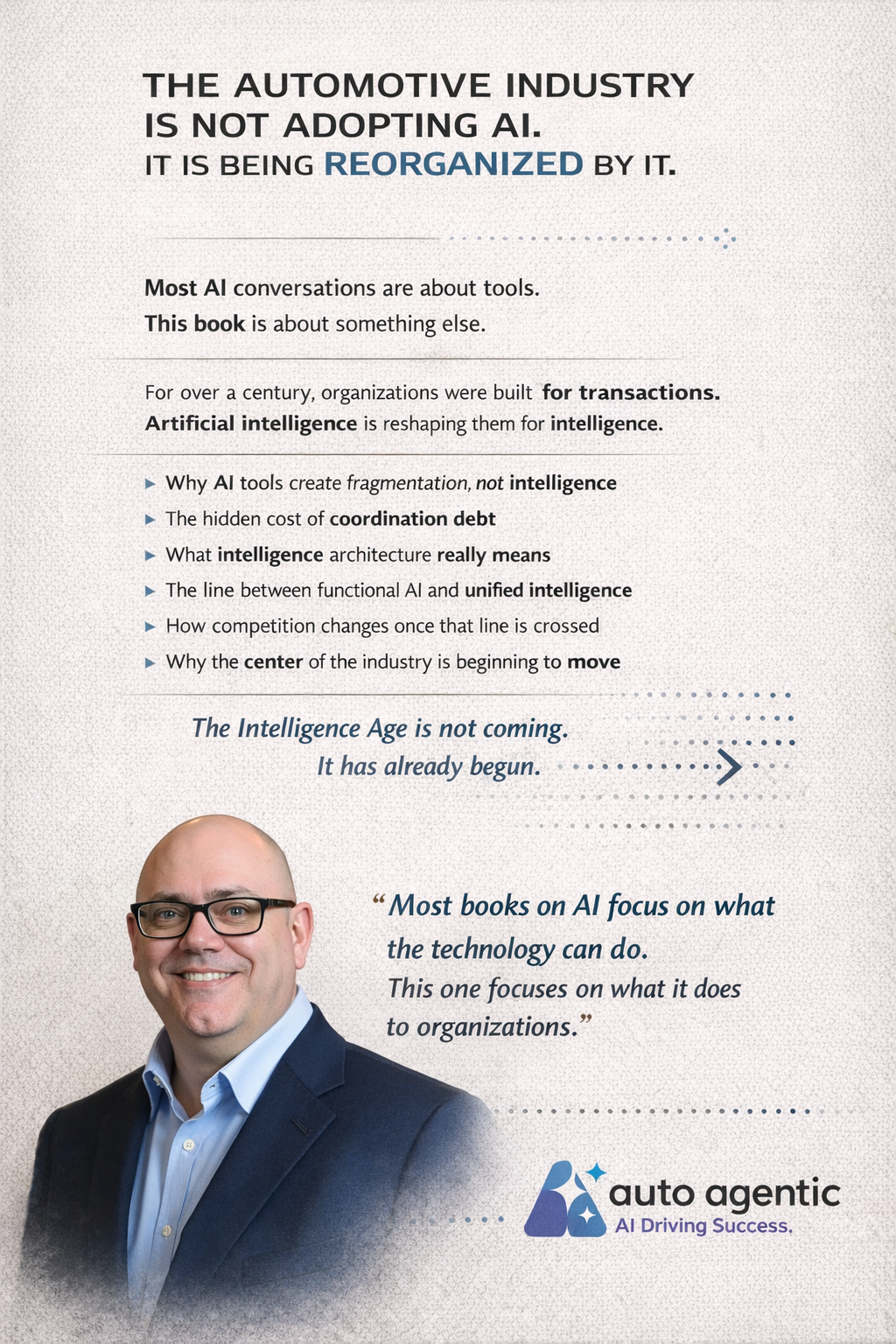
The automotive industry is not adopting AI. It is being reorganized by it.
New automotive AI playbook exposes 'coordination debt' crisis - why industry AI wins create operational problems, not intelligence. Free guide by Hillier.
The automotive industry's celebrated AI wins are creating a hidden crisis of "coordination debt" that threatens future competitiveness, according to a new AI playbook for the automotive industry by technology entrepreneur Barry Hillier. The guide, "From the Transactional Age to the Intelligence Age," reveals that most organizations are succeeding at building the wrong version of AI.
The uncomfortable reality facing automotive leaders
"Walk into any dealership or Original Equipment Manufacturer (OEM) today, and you'll hear the same story: 'We're implementing AI,'" said Hillier, CEO of Auto Agentic AI. "Customer Relationship Management Intelligence, service optimization, predictive analytics, impressive dashboards, measurable wins. And yet, something feels heavier instead of lighter. More systems to reconcile. More meetings to align Intelligence. More decisions require human coordination between AI recommendations."
The 181-page automotive AI playbook diagnoses "coordination debt"—the hidden organizational drag that builds when multiple AI tools fail to work together, creating complex new problems rather than solving old ones.
Industry research confirms the coordination crisis
Recent automotive industry analysis reveals the scope of this challenge. While 95% of dealerships view AI as important and report positive financial impacts, 78% remain uncertain about how to effectively use predictive capabilities. Integration complexity and coordination challenges are primary barriers to the systematic success of AI.
"The auto industry is repeating mistakes that stalled AI progress for decades," Hillier explained. "Leaders are celebrating wins from individual tools while accidentally building an organization that is more fragmented, not more intelligent."
The strategic framework that the industry has been missing
This automotive AI playbook provides the industry's first comprehensive framework for understanding why most automotive AI initiatives plateau at functional improvements instead of achieving systematic Intelligence coordination.
Key strategic insights include:
The 7-Stage Intelligence Maturity Framework: A roadmap showing why most companies get stuck with individual AI tools and fail to build coordinated organizations.
The Coordination Debt Crisis: How accumulating AI tools without coordination protocols creates an increasing organizational burden rather than a competitive advantage.
The Executive Paradox: Why Digital Age success instincts actively work against Intelligence Age requirements.
OEM-Dealer Intelligence Coordination: How ecosystem Intelligence emerges when organizations design for coordination rather than control.
Inside the comprehensive automotive AI playbook
The strategic guide is structured around three key parts that guide automotive leaders through understanding, diagnosing, and implementing Intelligence architecture:
Part 1: Understanding the Shift examines why AI represents an organizational age transition, not just a technology upgrade. It explores how coordination, rather than individual capability, determines AI success or failure, and provides technical foundations every leader must understand, including data lakes, retrieval architecture, and agentic systems. This section explains why memory design is a leadership decision that determines an organization's Intelligence capability.
Part 2: Diagnosing What You're Actually Building introduces the hidden cost accumulating when AI tools don't coordinate and presents the 7-Stage Intelligence Maturity Framework, showing where organizations actually stand versus where they think they are. Most remain stuck at Stage 3, missing the architectural crossing to Stage 4 where competitive advantages emerge. This section includes "The Mirror Test"—an assessment tool for honest evaluation of current AI investments and organizational readiness.
Part 3: Strategic Architecture and Implementation addresses OEM-dealer Intelligence coordination, shifting industry power dynamics, and the pioneer's strategic choice between building during formation versus adopting during maturation. It presents a vision of a transformed competitive landscape in which Intelligence coordination becomes a baseline expectation, supported by comprehensive implementation tools designed for immediate organizational application.
Practical implementation tools for automotive leaders
The comprehensive appendix transforms strategic concepts into executable frameworks:
AI Architecture Principles: Design guidelines ensuring every AI investment builds coordination rather than fragmentation
AI Investment Audit: 30-45 minute evaluation determining whether current AI systems coordinate or create coordination debt
Intelligence Readiness Assessment: Leadership and organizational capability diagnostic
Vendor Evaluation Framework: Strategic procurement criteria distinguishing coordination-enabling partners from sophisticated silo creators
Strategic timing for automotive industry pioneers
According to Hillier, the automotive industry is in a critical "formation period" in which organizations that think architecturally about AI will establish standards that others inherit.
"2026 is the inflection point. Organizations building AI architecture now will set standards others inherit. The race isn't for better tools—it's for systematic intelligence."
The strategic guide addresses automotive executives responsible for AI transformation:
CEOs and General Managers making strategic AI investment decisions
CFOs and COOs evaluating return on investment for intelligence architecture vs. tool accumulation
CTOs and CIOs designing technical foundations for coordinated intelligence
Dealer Principals determining whether AI strengthens or fragments operations
OEM Strategy Leaders navigating ecosystem intelligence coordination
"This isn't a vendor pitch," Hillier emphasized. "I'm making it completely free because I'd rather the industry develop with clear frameworks than through expensive trial-and-error that sets problematic standards everyone inherits."
The automotive AI playbook is available for free download at https://autoagentic.ai/book, with no email registration required.
About Barry Hillier
Barry Hillier is a technology entrepreneur and intelligence-architecture strategist with more than 30 years of experience building companies across AI, automotive technology, and strategic consulting. He is the co-founder of Auto Agentic AI and creator of the Auto Intelligence Podcast.
Barry Hillier
Auto Agentic AI
+1 647-300-0760
email us here
Visit us on social media:
LinkedIn
Legal Disclaimer:
EIN Presswire provides this news content "as is" without warranty of any kind. We do not accept any responsibility or liability for the accuracy, content, images, videos, licenses, completeness, legality, or reliability of the information contained in this article. If you have any complaints or copyright issues related to this article, kindly contact the author above.
